
ISO 27001 Certification in Arusha: Why Local Businesses Are Taking Data Security Seriously
A safari operator in Arusha might hold passport scans, card details and medical notes for hundreds of guests in a single season. Most of it sits in email inboxes, shared folders and booking platforms that nobody has reviewed in years.
That’s usually where the conversation about ISO 27001 Certification Arusha begins. A client asks how their data is protected, a tender asks for proof, or a phishing email gets through and someone realises there’s no plan. This guide covers what the standard involves, why it matters in Arusha specifically, and what the path to certification looks like.
ISO 27001 sets out the requirements for an Information Security Management System, usually shortened to ISMS. It isn’t a piece of software. It’s a structured way of finding out where your information is at risk and putting sensible controls in place to protect it.
The standard revolves around three principles, often called the CIA triad:
- Confidentiality: only authorised people can see the information.
- Integrity: information stays accurate and isn’t altered without permission.
- Availability: systems and data are there when your team and clients need them.
The current version is ISO/IEC 27001:2022, which reorganised the Annex A controls into 93 controls across four themes: organisational, people, physical and technological. If you want the full background, our guide on what ISO 27001 is and how it works goes into more detail.
Why Information Security Matters So Much in Arusha
Arusha isn’t a typical regional town. It hosts the East African Community headquarters, international courts, dozens of NGOs and a large share of Tanzania’s tourism trade. That mix creates a lot of sensitive data moving through relatively small organisations.
Tourism and Hospitality Handle More Data Than They Realise
Tour operators, lodges and travel agents collect personal details from guests in dozens of countries. Many of those guests come from Europe, where people are used to strict data protection, and overseas agents increasingly ask partners how guest data is stored and shared.
Tanzania Now Has Its Own Data Protection Law
The Personal Data Protection Act of 2022 introduced formal rules for how organisations collect, store and transfer personal data, overseen by the Personal Data Protection Commission. ISO 27001 doesn’t guarantee legal compliance on its own, but it gives you the controls, records and risk assessments that make meeting the law far more manageable.
The Threats Are Already Here
- Phishing emails that imitate booking platforms, banks or overseas agents.
- Business email compromise, where fraudsters change payment details on a genuine-looking invoice.
- Ransomware that locks booking systems or accounting files during peak season.
- Lost or stolen laptops and phones carrying unencrypted client data.
- Former staff who still have access to shared drives and email accounts.
None of these need a sophisticated hacker. Most succeed because nobody owned the risk, and that’s exactly the gap ISO 27001 is designed to close.
It’s worth being honest here: no standard makes a business immune to attack. What ISO 27001 Certification Arusha does is shorten the distance between spotting a problem and dealing with it. Staff recognise suspicious emails sooner, access gets removed when people leave, and there’s a tested plan when something slips through.
The Real Benefits of Getting Certified
Having a few security policies is a good start. Certification goes further, because an independent auditor has to see those policies working in day-to-day practice.
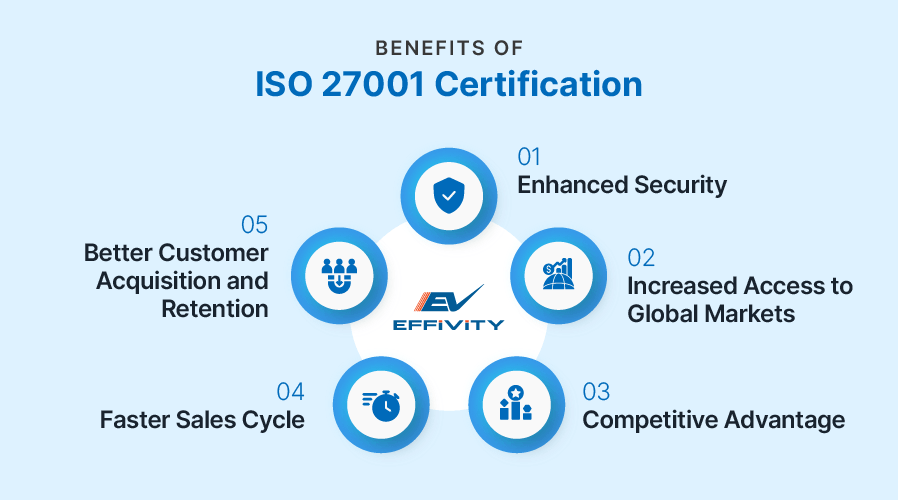
- Stronger tender responses: international organisations, banks and government bodies often ask suppliers for evidence of information security. A certificate answers that in one line.
- Client confidence: overseas partners and agents can see that their data is handled to an internationally recognised standard.
- Fewer incidents, because risks are identified and treated before they turn into breaches.
- Clearer responsibilities, so staff know who approves access, who handles incidents and who reports to management.
- A head start on data protection compliance, since many of the records regulators expect are already in place.
For many firms, the tipping point is commercial rather than technical. Pursuing ISO 27001 Certification Arusha often starts because one large client or donor makes it a condition of the next contract, and the business decides it’s cheaper to get certified than to keep answering long security questionnaires.
There’s also a quieter benefit. Businesses that go through the process usually end up with tidier systems, fewer forgotten accounts and a better idea of where their information actually lives.
Basic IT Security vs ISO 27001 Certification
Plenty of Arusha businesses have antivirus software and a firewall. Here’s how that compares with a certified ISMS:
| Area | Basic IT Security | ISO 27001 Certified ISMS |
|---|---|---|
| Focus | Mainly technical tools such as antivirus and firewalls | People, processes, suppliers and technology together |
| Ownership | Left to one IT person or an outside technician | Top management accountable, with defined roles |
| Risk management | Reactive, usually after something goes wrong | Formal risk assessment with a documented treatment plan |
| Staff awareness | Occasional reminders, if any | Regular training that forms part of the system |
| Supplier control | Rarely checked | Security requirements agreed and monitored |
| Proof for clients | “We take security seriously” | Accredited certificate plus annual surveillance audits |
Which Arusha Organisations Should Consider ISO 27001
Any organisation that handles sensitive information can use the standard. In Arusha, these sectors tend to feel the need first:
- Tour operators, safari companies, lodges and travel agencies.
- Banks, microfinance institutions and SACCOs.
- NGOs and contractors working with international organisations and donors.
- Hospitals, clinics and diagnostic laboratories.
- Law firms, accountants and consultancies holding client files.
- IT companies, software developers and managed service providers.
Size isn’t a barrier. A 25-person tour company doesn’t need the same scope as a bank, and the system can be built around your actual operations rather than a template.
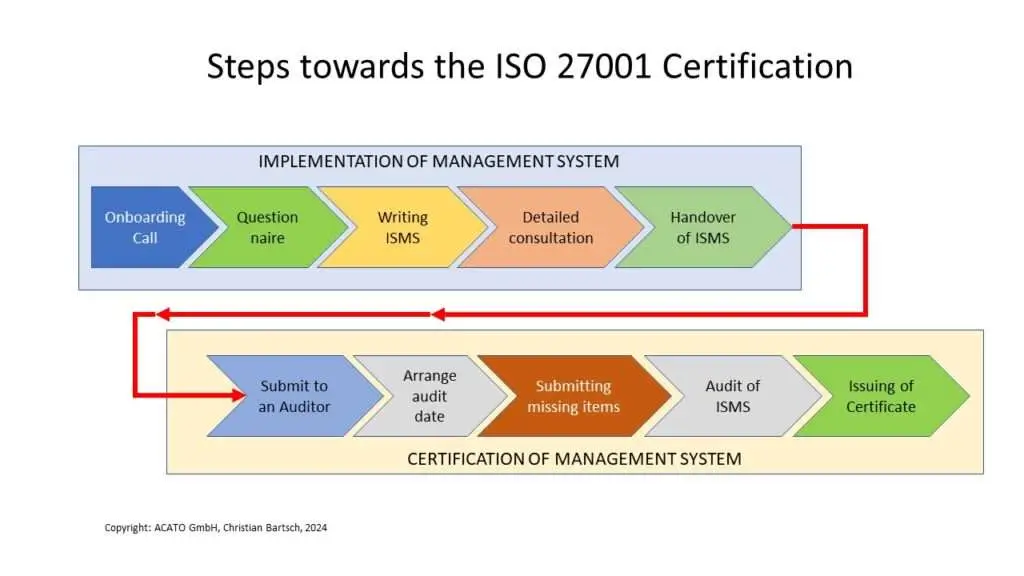
How the Certification Process Works
The details vary from one organisation to the next, but most projects follow the same broad steps:
- A gap analysis to compare your current practices with the standard.
- Defining the scope of the ISMS, such as which sites, systems and teams it covers.
- A risk assessment and a risk treatment plan.
- Writing the required policies, procedures and the Statement of Applicability.
- Rolling out controls and training staff.
- An internal audit and management review.
- The external certification audit, carried out in two stages by an accredited certification body.
Our guide to ISO certification audit stages explains what happens at Stage 1 and Stage 2. Before you begin, the checklist of documents required for ISO certification is worth a read, since good preparation saves weeks.
It also helps to understand who does what. Our article on the difference between an ISO consultant and a certification body clears up a common point of confusion.
Working With ISO Consultants in East Africa
You can build an ISMS in-house, but most first-time projects move faster with experienced help. A consultant who knows the region understands how local businesses actually operate, from mixed paper and digital records to teams that switch between Swahili and English.
Our team of ISO consultants in East Africa supports organisations across Tanzania and Kenya. If you’re still weighing it up, here’s why hiring ISO consultants can speed up certification.
ISO 27001 also sits comfortably beside other standards. It shares a structure with ISO 9001 and pairs especially well with ISO 22301 business continuity management, since backups and incident response overlap heavily.
Frequently Asked Questions
How long does ISO 27001 certification take?
Most organisations take three to six months from gap analysis to the certification audit. It depends on your size, scope and how much documentation already exists.
Is ISO 27001 compulsory in Tanzania?
No, certification is voluntary. However, clients, donors and tender boards increasingly expect it, and it supports compliance with Tanzania’s data protection requirements.
Do we need to renew the certificate?
A certificate is valid for three years, with surveillance audits every year and a recertification audit at the end of the cycle.
Final Thoughts
Arusha’s businesses deal with international guests, donors and partners every day, and they’re trusted with a lot of personal and financial data. ISO 27001 Certification Arusha gives organisations a practical, tested way to protect that trust and prove it to anyone who asks.
- It turns information security from a loose set of habits into a managed system.
- It supports your obligations under Tanzania’s data protection law.
- It gives clients and tender boards independent proof that their data is safe with you.
Ready to Protect Your Business Information?
AceQu helps organisations in Arusha and across East Africa plan, build and certify an ISO 27001 information security management system, from the first gap analysis through to the final audit. Book a free consultation and find out where you stand today.
Talk to Our ISO 27001 TeamFor the standard’s own summary, see ISO’s page on ISO/IEC 27001, or this general overview of ISO/IEC 27001 on Wikipedia.