
ISO 45001 Certification Nairobi: Where Safer Workplaces Actually Start
A scaffold plank slips on a building site off Ngong Road. A forklift clips a loader in an Industrial Area warehouse. Neither makes the news, but both cost a family a wage and a business its reputation. An ISO 45001 occupational health and safety management system exists to stop moments like these before they happen.
For many employers, ISO 45001 certification Nairobi projects start with a tender requirement or an insurer’s question. They tend to finish with something more useful: a workplace where people know the risks, speak up about them and go home in one piece.
Below, we’ll cover what the standard asks of you, how it improves safety on the ground, how it sits alongside Kenyan law and what the certification journey looks like.
What ISO 45001 Actually Is
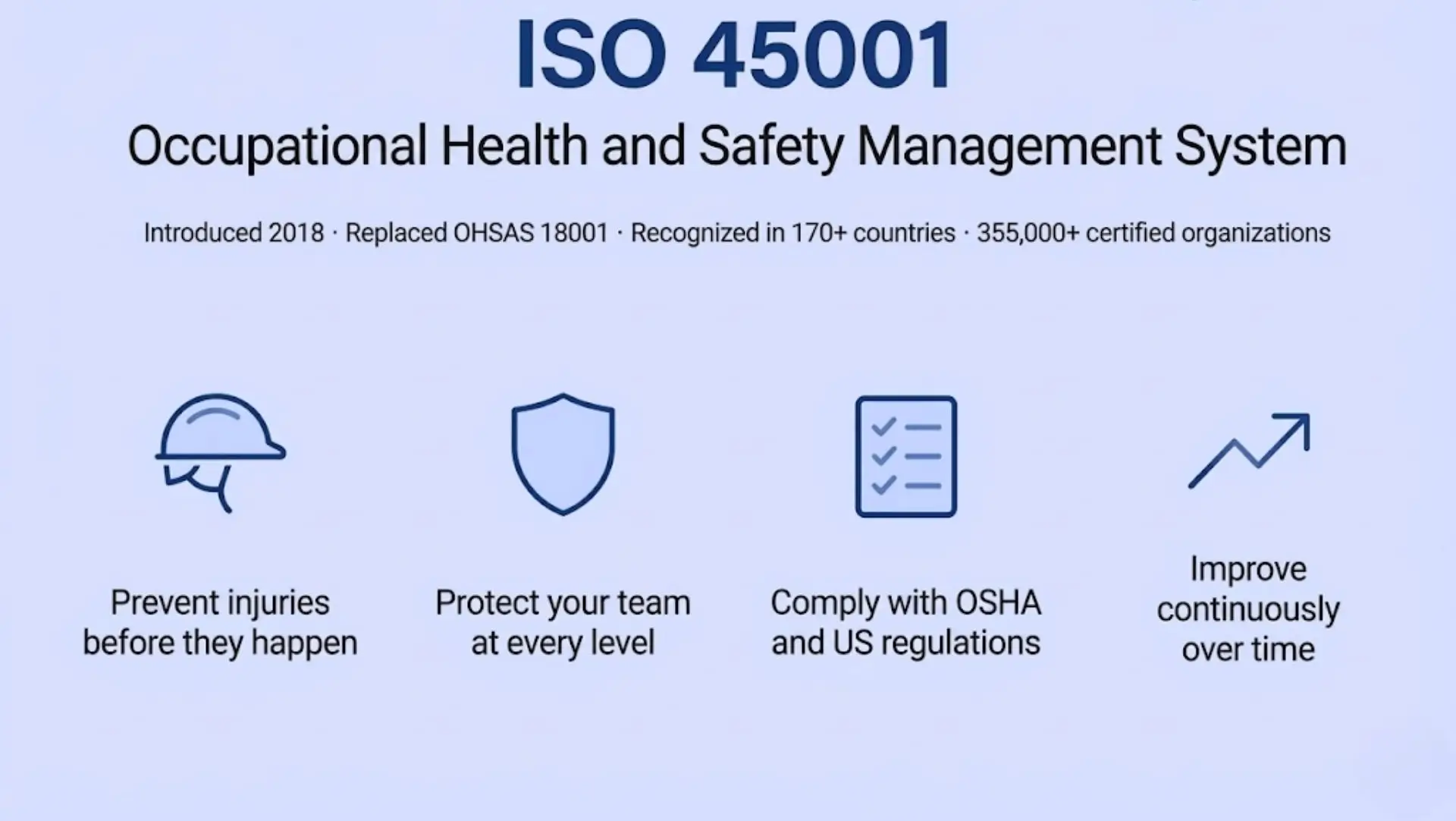
ISO 45001:2018 is the international standard for occupational health and safety (OH&S) management. It replaced the older OHSAS 18001, and it gives organisations a structured way to prevent work-related injury and ill health.
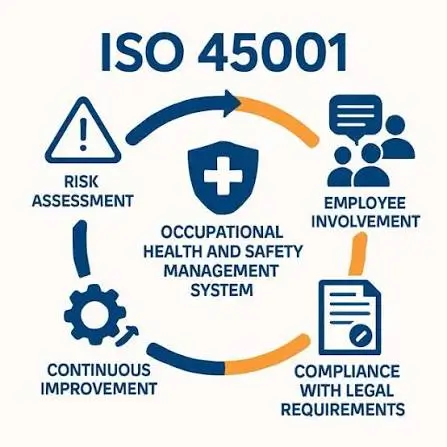
It isn’t a checklist of hard hats and fire extinguishers. Instead, it asks you to build a system around these elements:
- Hazard identification: finding what could hurt people in every task, site and shift.
- Risk assessment and controls: deciding which risks to remove first and how to control the rest.
- Worker consultation and participation, so the people doing the job have a real say in how it’s made safer.
- A clear view of your legal obligations and how you’re meeting them.
- Emergency preparedness for fires, spills, medical incidents and evacuations.
- Incident investigation that looks for root causes rather than someone to blame.
- Management review and continual improvement, so the system gets better each year.
The official summary is on ISO’s page for ISO 45001:2018 if you’d like to read it in the standard’s own words.
The Safety Risks Nairobi Workplaces Deal With Every Day
Nairobi’s economy is busy, crowded and fast-moving. That brings opportunity, and it also brings a familiar set of hazards:
- Working at height on the construction sites spreading across Westlands, Kilimani and the city’s outskirts.
- Heavy machinery, forklifts and moving parts in factories and warehouses along Mombasa Road and in Industrial Area.
- Fire risk in markets, godowns and older buildings, where exits and electrical wiring aren’t always what they should be.
- Road risk for drivers, riders and delivery staff navigating heavy city traffic every day.
- Chemical exposure in cleaning, printing, manufacturing and laboratory work.
- Less visible risks in offices, such as poor ergonomics, long hours and work-related stress.
Most of these are well known. The problem is rarely that nobody has noticed the risk. It’s that nobody owns it, nobody checks the controls and the same near miss keeps happening until one day it isn’t a near miss.
How ISO 45001 Certification Improves Workplace Safety
Certification means an independent auditor has checked that your safety system works in practice. That outside pressure changes behaviour in ways a policy document on the wall never quite manages.
Hazards Get Spotted Earlier
Regular risk assessments and site inspections become routine rather than a reaction to an accident. Supervisors start looking for problems before an auditor or an inspector finds them.
Workers Get a Real Voice
ISO 45001 puts heavy weight on consulting non-managerial staff. The people on the shop floor usually know exactly where the danger is, and the standard gives them a formal way to say so without fear of blame.
Leadership Takes Ownership
Top management can’t hand safety to one officer and walk away. The standard makes leaders accountable for setting objectives, providing resources and reviewing results.
Incidents Turn Into Lessons
- Near misses are reported and recorded instead of quietly forgotten.
- Investigations look at systems and conditions, not just the individual involved.
- Corrective actions are tracked until they’re actually closed.
How ISO 45001 Fits With Kenyan Safety Law
Kenyan employers already carry legal duties under the Occupational Safety and Health Act 2007 and the Work Injury Benefits Act 2007, overseen by the Directorate of Occupational Safety and Health Services (DOSHS). These include registering workplaces, running safety and health committees where required, and arranging regular safety audits.
ISO 45001 doesn’t replace any of that. What it does is give you one organised system for tracking every obligation, keeping records and proving compliance when an inspector or client asks. Many businesses find their statutory audits go far more smoothly once the system is in place.
Basic Compliance vs ISO 45001 Certification
Here’s how a minimum-compliance approach compares with a certified system:
| Area | Basic Legal Compliance | ISO 45001 Certified System |
|---|---|---|
| Approach | Reacts to inspections and incidents | Prevents harm through planned risk management |
| Ownership | Usually left to one safety officer | Top management accountable, with roles at every level |
| Worker involvement | Limited to the committee, if one exists | Structured consultation across teams and shifts |
| Near misses | Often ignored or unreported | Recorded, investigated and used to improve controls |
| Contractors | Left to manage their own safety | Brought inside your safety rules and checks |
| Proof for clients | Internal records only | Internationally recognised certificate from an accredited body |
The Business Benefits Go Beyond Safety
Fewer injuries is the main point, but it’s far from the only return. Nairobi businesses that achieve certification commonly see:
- A stronger position in tenders, especially with multinationals, government bodies and large contractors that screen suppliers on safety.
- Less lost time from injuries and sick leave, which keeps projects on schedule.
- Better conversations with insurers, since you can evidence how risks are controlled.
- Higher staff morale and retention, because people notice when an employer takes their wellbeing seriously.
- Protection for your reputation when something does go wrong, backed by records showing you acted responsibly.
Which Nairobi Businesses Benefit Most
Any organisation can use ISO 45001, from a 15-person workshop to a national employer. That said, it pays off fastest in higher-risk sectors:
- Construction firms and contractors working on high-rise, road and infrastructure projects.
- Manufacturers, processors and packaging plants in Industrial Area and along Mombasa Road.
- Logistics, warehousing and transport companies around JKIA and the city’s distribution hubs.
- Hospitals, clinics and laboratories handling biological and chemical hazards.
- Hotels, security firms and facilities management companies with large shift-based teams.
- Energy, telecoms and engineering firms whose staff work at height or near live equipment.
What the Road to ISO 45001 Certification Looks Like
Most projects follow a similar path, whatever the size of the business:
- A gap analysis comparing your current safety arrangements with the standard.
- Hazard identification and risk assessments across every site and activity.
- Policies, procedures and controls built around the risks that actually matter to you.
- Training for managers, supervisors and workers, plus emergency drills.
- An internal audit and management review to confirm everything works.
- A two-stage certification audit by an accredited certification body.
Our guide to ISO certification audit stages explains what auditors look for at each stage. Before you begin, it’s worth checking our list of documents required for ISO certification, and our breakdown of ISO certification cost in Kenya will help you plan the budget.
It Works Well With Other ISO Standards
ISO 45001 uses the same high-level structure as ISO 9001 quality management and ISO 14001 environmental management. If you already hold either, your document control, internal audits and management reviews carry straight over.
Health, safety and environment often sit with the same team anyway. That’s why many Nairobi manufacturers and contractors combine all three into one integrated management system and run a single audit programme.
Frequently Asked Questions
Is ISO 45001 certification mandatory in Kenya?
No, it’s voluntary. Legal compliance with OSHA 2007 is mandatory, though, and ISO 45001 is one of the most practical ways to manage and prove that compliance.
We’re still on OHSAS 18001. What now?
OHSAS 18001 has been withdrawn and replaced by ISO 45001, so any remaining OHSAS-based system needs to move across. Much of your existing documentation can be reused, but the newer standard expects more leadership involvement and worker consultation.
How long does certification take?
Most organisations take four to six months, depending on size and how organised current safety records are. Experienced help usually shortens that, as our article on why hiring ISO consultants can speed up certification explains.
Final Thoughts
Safety failures in Nairobi rarely come from nowhere. They build up through small gaps that nobody owns. For ISO 45001 certification, Nairobi businesses get a tested framework that closes those gaps and proves it to clients, regulators and staff.
- It shifts safety from reacting to incidents to preventing them.
- It gives workers a genuine say in how their jobs are made safer.
- It strengthens tender bids and supports compliance with Kenyan law.
Ready to Make Your Workplace Safer?
AceQu helps organisations across Nairobi and East Africa implement and certify ISO 45001 occupational health and safety systems, from the first gap analysis to the final audit. Book a free consultation and find out how close you already are.
Talk to Our ISO 45001 TeamFor more background on the standard’s history and scope, see this overview of ISO 45001.