
ISO 20000-1 Certification Kisumu: Where IT Companies Should Start
A county tender lands in your inbox, the scope looks perfect, and then you spot the requirement for a certified IT service management system. If you run an IT company in Kisumu, that moment is becoming more common, and it’s usually the first time the team properly looks at ISO 20000-1 IT service management certification.
This guide explains what ISO 20000-1 Certification Kisumu firms are being asked for actually involves, why it’s worth the effort, and how the process works from the first gap analysis to the final audit. No theory for its own sake, just what you need to decide whether it fits your business.
What ISO 20000-1 Actually Is
ISO/IEC 20000-1:2018 is the international standard for IT service management. It sets out the requirements for a Service Management System (SMS), which is simply the set of policies, processes and records you use to plan, deliver and improve the IT services your clients pay for.
If you’ve heard of ITIL, you’re halfway there. ITIL is a library of good practice. ISO 20000-1 is the auditable standard, so an independent body can check that your organisation genuinely works that way and issue a certificate to prove it.
What the Standard Asks You to Put in Place
- A service catalogue: a clear list of the services you offer and what each one includes.
- Service level agreements: agreed targets for response times, resolution times and availability, tracked and reported.
- Incident and service request management, so tickets are logged, prioritised and closed consistently.
- Problem management, which digs into the root cause of repeat issues rather than fixing the same fault every week.
- Change and release management, so updates don’t knock a client’s system over on a Friday afternoon.
- Supplier management for the vendors, ISPs and cloud providers your services depend on.
- Capacity, availability and service continuity planning.
- Internal audits, management review and continual improvement.
For the official description, see ISO’s page for ISO/IEC 20000-1:2018.
Why It Matters for IT Companies in Kisumu
Kisumu’s tech scene has grown quickly. Managed service providers, software houses, hosting firms and support teams now serve clients across Western Kenya, in Nairobi and increasingly abroad. With that growth comes tougher questions from buyers.
Tenders and Procurement
County governments, banks, SACCOs, universities and NGOs often want evidence that a supplier can deliver IT services reliably. A certificate answers that in one line of a bid document, instead of three pages of explanation that an evaluator may or may not read.
Competing Beyond the Lakeside
When a Kisumu firm pitches against a Nairobi or international competitor, being local is an advantage but rarely enough on its own. ISO 20000-1 puts you on equal footing on paper, so the conversation can move on to price, responsiveness and relationships, where local firms usually do well.
Less Firefighting Inside the Business
- Engineers stop reinventing how to handle the same ticket types.
- Clients get consistent service whether your best technician is in the office or on leave.
- SLA reports become something you can show with confidence, not something you dread.
- New staff get up to speed faster because the processes are written down.
Winning and Keeping Overseas Clients
Remote work has opened doors for Kisumu firms to support clients in Europe, the Middle East and North America. Those buyers rarely have time to visit, so they lean heavily on recognised certifications during due diligence. ISO 20000-1 tells them your service desk, escalation paths and change controls meet an international benchmark before the first call.
It also helps you keep those clients. When a contract comes up for renewal, SLA reports backed by a certified system make a far stronger case than a handful of happy emails.
What Auditors Actually Look For
Auditors care less about how polished your documents look and more about whether daily work matches them. During an ISO 20000-1 audit, expect them to:
- Pick a few recent tickets and trace them from logging to closure.
- Ask engineers how they’d handle a major incident, then compare the answer with your procedure.
- Check that changes were approved and tested before going live.
- Compare SLA reports with what clients were actually promised.
- Look for evidence that management reviews lead to real decisions.
ISO 20000-1 vs ITIL vs ISO 27001
These three get mixed up all the time. Here’s how they differ in practice:
| Area | ISO 20000-1 | ITIL | ISO 27001 |
|---|---|---|---|
| What it is | International standard for IT service management | Good practice framework and guidance | International standard for information security |
| Main focus | Delivering IT services to agreed levels | How to run service management activities | Protecting data and systems |
| Who gets certified | The organisation | Individual professionals | The organisation |
| Independent audit | Yes, by an accredited certification body | No organisational audit | Yes, by an accredited certification body |
| Typical trigger | Tenders, SLA-heavy contracts, outsourcing deals | Staff training and career development | Handling sensitive client data, security requirements |
Many IT firms hold ISO 20000-1 and ISO 27001 information security together, since both share the same management system structure and a lot of the same records. If you want the background on the security side first, our guide explaining what ISO 27001 is is a good starting point.
Who Should Consider It in Kisumu
The standard applies to any organisation that delivers IT services, internally or to customers. In Kisumu, that usually means:
- Managed service providers looking after networks, devices and support for local businesses.
- Software development companies that also host, maintain and support what they build.
- Internet service providers and hosting or data centre operators.
- BPO and remote support firms serving clients outside Kenya.
- In-house IT departments at hospitals, universities, SACCOs and county offices that want a structured way to serve the rest of the organisation.
Size isn’t the barrier people assume. A ten-person MSP can be certified, with a leaner system than a national telco would need.
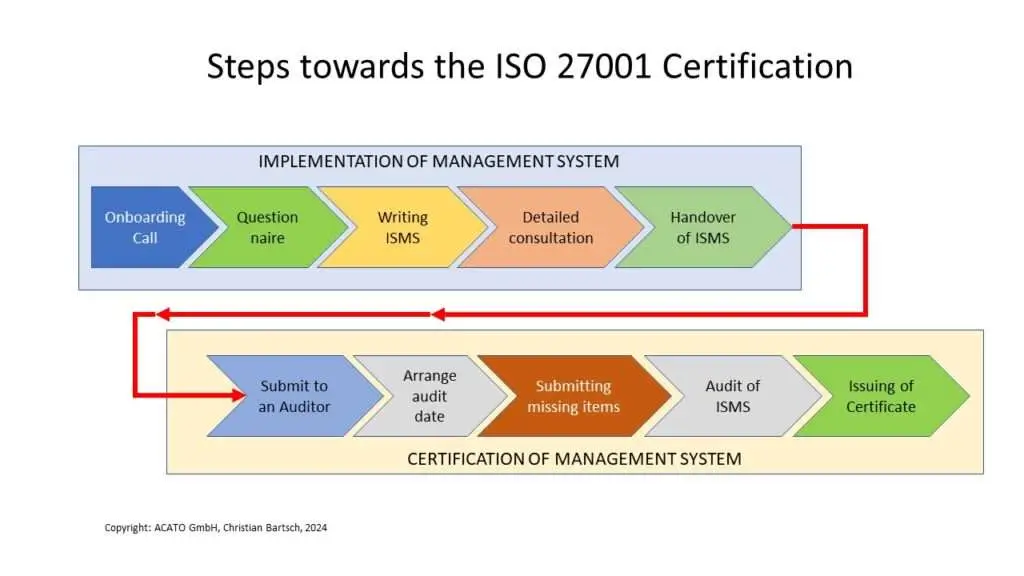
The Certification Process, Step by Step
- Gap analysis, comparing how you work today with the standard’s requirements.
- Defining the scope, meaning which services, locations and clients the SMS will cover.
- Building or tidying up your processes, from incident handling to change control.
- Writing the required policies and records, then using them for a few months so there’s real evidence.
- Staff training, an internal audit and a management review.
- The two-stage external audit by an accredited certification body.
Our walkthrough of ISO certification audit stages explains what the auditor looks for in Stage 1 and Stage 2. It helps to read our checklist of documents required for ISO certification early, too, because gathering evidence usually takes longer than writing policies.
Common Mistakes to Avoid
- Buying a template pack and assuming the job is done. Auditors check whether your team actually follows the documents.
- Setting SLA targets you can’t meet, just because they look good in a proposal.
- Leaving suppliers out of scope, even though an ISP outage can break every service you offer.
- Treating it as an IT manager’s side project with no backing from leadership.
- Rushing to the audit before you have a few months of tickets, change records and reports to show.
How Long It Takes and What It Costs
Most Kisumu IT firms can expect four to eight months from gap analysis to certificate. Firms already running a ticketing tool and some ITIL practices often land at the shorter end.
Cost depends on your headcount, the number of services in scope and how much groundwork is already done. Our breakdown of ISO certification cost in Kenya covers the main factors, and working with experienced ISO consultants in East Africa can save a good chunk of rework.
Frequently Asked Questions
Is ISO 20000-1 only for large IT companies?
No. The standard scales to the size of your business, and small firms often find it easier because they have fewer services and teams to align.
Do we need ITIL-certified staff first?
It helps, but it isn’t required. ITIL knowledge makes the processes feel familiar, while ISO 20000-1 is what the auditor assesses.
How long is the certificate valid?
Certificates usually run for three years, with annual surveillance audits in between to confirm the system is still working.
Final Thoughts
For IT firms around the lake, ISO 20000-1 Certification Kisumu clients and tender boards recognise is quickly becoming the difference between being shortlisted and being overlooked. More importantly, it gives your team a calmer, more predictable way to deliver the services you’re already selling.
- It proves your service delivery to clients who have never met you.
- It cuts repeat incidents and the stress that comes with them.
- It sits comfortably alongside ISO 27001 if security is also on your list.
Ready to Take Your IT Services to Certification?
AceQu supports IT companies in Kisumu and across East Africa with ISO 20000-1 gap analysis, implementation and audit preparation. Book a free consultation and find out how close you already are.
Talk to Our ISO 20000-1 TeamFor wider background on the standard, see this overview of ISO/IEC 20000.