

AceQu’s Guide to Implementing a QMS System for East African and West African Companies
In order to achieve excellence, implementing a Quality Management System (QMS) should be one of the first steps for businesses throughout East Africa and West Africa. Businesses in Kenya, Uganda, Tanzania, Rwanda, Ethiopia, Nigeria, Ghana, Ivory Coast, Senegal and Liberia can benefit from a robust QMS system by meeting international standards, improving customer satisfaction, and enhancing the credibility of their business.

We have created a step-by-step guide to help businesses implement a QMS system and provide best practices for companies operating in multiple countries in East Africa and West Africa.
What is a QMS system?
The Quality Management System (QMS) is a systematic approach that helps businesses standardise their processes, manage their risks, and drive ongoing improvement in the way they operate.
In the East African region, countries such as Kenya, Uganda, Tanzania, Rwanda, Burundi, Ethiopia, South Sudan, and Malawi are increasingly putting in place ISO 9001-certified QMS to align themselves with international business standards.
In the West African region, countries such as Nigeria, Ghana, Ivory Coast, Senegal, Liberia, Sierra Leone, Togo, and Benin are using QMS to improve their operational efficiencies and meet international standards.
Typical parts of a QMS are:
1. Written Procedures and Processes
2. Internal audits and compliance checks
3. Corrective and Preventative Action Plans
4. Continuous Improvement Initiatives
5. Employee training and awareness programmes
Using a QMS will allow businesses in the East African and West African regions to maintain consistency, minimise errors and build trust with their customers.
Why Companies in East & West Africa Need a QMS System
The businesses in both East and West Africa face a myriad of challenging operational hurdles. The complexity of managing a multinational supply chain in the region, such as in Kenya, Uganda, Tanzania, Rwanda, Ethiopia, Nigeria, Ghana, Senegal and Cote d’Ivoire, necessitates that the processes across these countries have the same base standards and quality control measures in place.
The following are the benefits of using an ISO9001-compliant Quality Management System (QMS) on the continent of Africa, by country:
1. Increase in Operational Efficiency – By creating a standard way for employees to complete work,
2. A QMS system allows each employee in all of the East African countries (Kenya, Uganda, Tanzania, Rwanda, and Ethiopia) and the West African countries (Nigeria, Ghana, Cote d’Ivoire, Senegal, Liberia, and Sierra Leone) to understand what their specific responsibilities are, ultimately creating a more efficient workplace.
Steps to Implement a QMS System Across East & West Africa
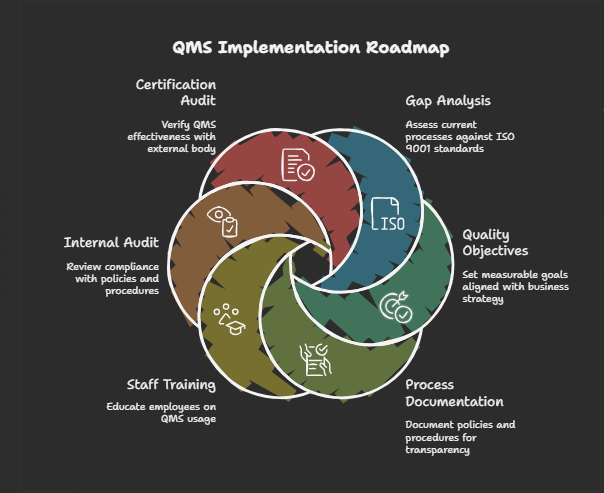
A systematic approach is required to successfully implement a Quality Management System (QMS) in several countries. The following is a roadmap for companies in both East and West Africa.
1. Performing a “Gap Analysis”
The first step is to assess the company’s current processes and determine how they compare to the ISO 9001 standards. Companies based in the countries of Kenya, Uganda, Tanzania, Rwanda, Ethiopia, Nigeria, Ghana, Côte d’Ivoire, Senegal, and Liberia will benefit from conducting this assessment.
2. Establish Quality Objectives
Companies should develop measurable quality goals that are in line with their overall business goals and should be customised based on the current conditions within East Africa and West Africa.
3. Create Process Documentation
To ensure that processes, policies, and personnel are documented, process documentation enhances transparency and provides enhanced preparation for ISO audits for companies that are situated in the following countries: Kenya, Uganda, Tanzania, Nigeria, Ghana, Côte d’Ivoire, Senegal, and Liberia.
4. Training Staff on the QMS
The staff needs to know how to effectively use the QMS. Staff involvement in Eastern African countries (Kenya, Uganda, Tanzania, Rwanda, Ethiopia, etc.) and many other West African countries (Nigeria, Ghana, Côte d’Ivoire, Senegal, Liberia, Sierra Leone, Togo, Benin) is vital to properly implementing the QMS.
5. Internal Audit and Review
Regularly conduct audits to determine whether the business is operating in compliance with its policies and procedures. Businesses throughout East Africa (Kenya, Uganda, Tanzania, Rwanda, Ethiopia, Malawi, Burundi, and South Sudan) and West Africa (Nigeria, Ghana, Côte d’Ivoire, Senegal, Liberia, Sierra Leone, Togo, and Benin) audit their organisations and have corrective actions for issues identified during audits.
6. Certification Audit
After an organisation has implemented a Quality Management System (QMS), it can have a certification body perform an audit of the organisation. Certification indicates that the organisation is committed to producing quality products and services in its East and West African operations.
Best Practices for Companies in East & West Africa
1. Tailor your QMS system to the local business culture in Kenya, Uganda, Tanzania, Rwanda, Ethiopia, Nigeria, Ghana, Côte d’Ivoire, and Senegal.
2. Leverage technology to manage documents and processes across multiple countries.
3. Focus on continuous improvement; adapt the QMS system as your business evolves in East Africa and West Africa.
4. Engage leadership and staff across all branches in Kenya, Uganda, Tanzania, Rwanda, Nigeria, Ghana, Senegal, and Liberia.
5. Use professional ISO consultants to ensure smooth implementation across East African and West African markets.
Conclusion,
A quality management system (QMS) will give companies in East and West Africa a way to become compliant with ISO requirements and provide positive impacts on operational performance, risk management, customer confidence, and operational efficiency. Furthermore, QMS systems are valuable to companies in these regions because they are a long-term investment toward improved operational processes, increased operational efficiency, risk mitigation, and increased trust from customers, suppliers, and international markets.
Companies that have implemented a structured QMS will see the following benefits:
1. The companies that work with a professional ISO consultancy (like AceQu) to implement a structured QMS are assured of achieving ISO 9001 certifications and compliance with other QMS standards.
2. Able to develop a strong quality management system through tailored processes specific to their country’s needs.
3. Achieving a long-term growth strategy to gain recognition for their businesses internationally.
For any business within the East African or West African regions, establishing a proper QMS will allow them to maintain compliance with ISO 9001 or other standards, which will support them in reaching their long-term goals for sustainable business growth.